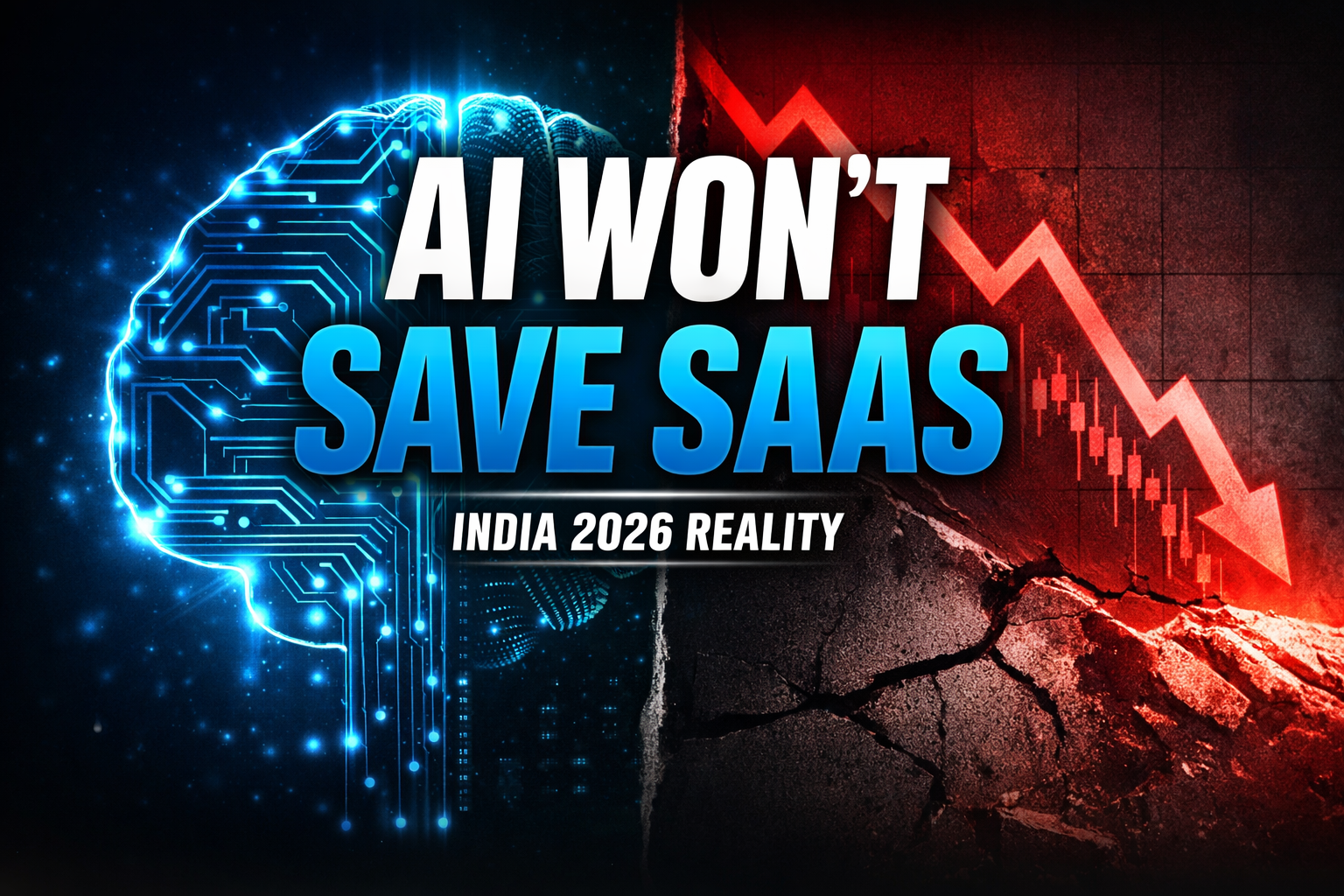
India’s SaaS ecosystem is often seen as one of the fastest-growing in the world.
From global success stories to a constant stream of new startups, the narrative looks strong on the surface. Companies continue to launch, raise funding, and expand internationally.
But beneath that growth, a different reality is emerging in 2026.
A growing number of Indian SaaS startups are struggling to survive.
- Funding is harder to secure
- Customer acquisition is getting expensive
- Retention is becoming the real bottleneck
- AI is leveling the playing field instead of creating advantage
This is not a collapse.
It’s a correction.
The Post-Boom Reality: From Growth to Survival
Between 2020 and 2022, SaaS startups operated in an unusually favorable environment:
- Easy access to capital
- Aggressive investor sentiment
- Growth prioritized over profitability
During this phase:
- Startups scaled quickly
- Acquisition costs were often ignored
- Burn rates were high
But that environment no longer exists.
In 2026:
- Investors demand efficiency
- Growth must be sustainable
- Metrics are closely scrutinized
Many startups are now facing a harsh truth:
They were built for a market that no longer exists.
AI Didn’t Save SaaS — It Changed the Game
Artificial Intelligence was expected to be a major advantage for SaaS companies.
And while it is powerful, it has created a new problem.
Most startups today:
- Use similar AI models
- Build similar features
- Offer similar experiences
This leads to rapid commoditization.
What once looked like innovation now becomes standard.
Instead of creating a moat, AI:
- Reduces barriers to entry
- Increases competition
- Makes differentiation harder
In simple terms:
AI doesn’t protect your business. It exposes it.
The Real Problem: Retention
For years, SaaS growth was driven by acquiring more users.
That model is breaking.
Acquiring customers is expensive.
Keeping them is what determines survival.
Startups are now dealing with:
- Users who sign up but don’t stay
- Low engagement after onboarding
- Weak expansion revenue
This results in high churn.
And churn quietly destroys SaaS businesses.
The Demo vs Reality Gap
AI has made it easier than ever to create impressive product demos.
Products feel smarter. Interfaces look more advanced.
But there is a gap between perception and value.
In demos:
- The product feels revolutionary
In reality:
- The value is unclear
- ROI is hard to measure
- Usage drops over time
Customers don’t pay for features.
They pay for outcomes.
If a product cannot clearly show business impact, it becomes replaceable.
Unit Economics Are Back
In the current market, fundamentals matter again.
Key metrics include:
- Customer Acquisition Cost (CAC)
- Lifetime Value (LTV)
- Payback Period
- Gross Margins
If acquisition costs are high and retention is low, the business becomes unsustainable.
What’s happening in 2026:
- Paid marketing is more expensive
- Conversion rates are declining
- Sales cycles are longer
This combination is difficult for most startups to handle.
Why Horizontal SaaS Is Under Pressure
Horizontal SaaS tools serve broad use cases.
These include:
- Generic CRMs
- Productivity tools
- General analytics platforms
They face pressure from:
- Large companies expanding features
- Faster competitors
- Customers reducing tool usage
Without strong differentiation, they become interchangeable.
The Rise of Vertical SaaS
Vertical SaaS focuses on specific industries.
These products are more resilient because they offer:
- Deep workflow integration
- Industry-specific solutions
- Higher switching costs
Depth creates defensibility.
And defensibility is what matters now.
The Global Expansion Challenge
Most Indian SaaS startups target international markets.
Especially the US and Europe.
But global expansion is not easy.
Challenges include:
- Longer sales cycles
- Higher expectations for trust
- More complex buying processes
Many startups underestimate these factors.
The result:
- Higher acquisition costs
- Slower growth
- Lower conversion rates
A Clear Signal From the Market
Recent shutdowns and struggles across SaaS highlight a pattern.
Even well-funded startups:
- Fail to sustain growth
- Struggle with retention
- Cannot justify their economics
This reinforces a key idea:
Funding does not fix weak fundamentals.
What’s Actually Working in 2026
The startups that are succeeding follow a different approach.
1. Retention First
They focus on keeping customers, not just acquiring them.
2. Clear ROI
They deliver measurable outcomes.
3. Deep Integration
Their products become essential to workflows.
4. Real Differentiation
They build true advantages, not just features.
5. AI as a Tool
They use AI to enhance value, not define the product.
Why Startups Are Really Failing
The issue is not just AI or funding.
It is a mismatch.
Startups were built for:
- Fast growth
- Easy capital
- Feature-driven competition
But the market now rewards:
- Efficiency
- Retention
- Real value
This shift is forcing a reset.
The Bigger Picture
This phase is not negative.
It is necessary.
Weak businesses are being filtered out.
Stronger ones are emerging.
This is how ecosystems mature.
Conclusion
Indian SaaS is not failing.
It is evolving.
The startups that survive will not be the ones with the most features or funding.
They will be the ones that:
- Deliver real value
- Retain customers
- Operate sustainably
- Build defensible businesses
That is what defines success in 2026.
Follow VentureBrief
For deep startup insights, real analysis, and no-hype breakdowns of SaaS, AI, and business:
Follow VentureBrief.Why Indian Deeptech Startups Are Losing to China Imports in 2026 (And How the Smartest Founders Are Surviving)Why Indian Deeptech Startups Are Losing to China Imports in 2026 (And How the Smartest Founders Are Surviving)Why Indian Deeptech Startups Are Losing to China Imports in 2026 (And How the Smartest Founders Are Surviving)Why Indian Deeptech Startups Are Losing to China Imports in 2026 (And How the Smartest Founders Are Surviving)